Undine documentation
Open source · alpha
An AI-native, web-based EDA environment for custom IC design.
Undine (pronounced uhn-deen) keeps the design, the PDK, DRC / LVS and simulation on a server, and lets the browser, scripts and AI agents work through the same API. An agent's edits arrive as a proposal that you review before anything changes.
Explore the documentation
-
Install with
./setup.sh, open a first project on the sky130 PDK. -
An inverter from schematic to layout, then with an agent, then to Tiny Tapeout.
-
Views side by side, and the goals, constraints and specs that checks work from.
-
Xschem-compatible
.sch/.symediting, netlists, symbols. -
KLayout tiles, PDK layers and PCells, schematic-driven layout.
-
ngspice with specs at corners, Verilator, LibreLane to GDS.
-
DRC, LVS, parasitic extraction and post-layout simulation.
-
Claude Code and Claude Desktop over MCP,
undine call, Python. -
Every proposal on a git branch: checks before and after, adopt or discard.
-
SKY130, GF180MCU, IHP SG13G2, and packages pinned in
undine.lock. -
Tiny Tapeout, wafer.space and ChipFoundry checks and bundles.
-
The
undinecommand, the data on disk, the HTTP API.
Tip
./setup.sh check (or pixi run doctor) says what is missing on your machine, and the command that fixes it.
Why Undine
The browser only draws
The database, PDK, PCell code, checks and simulation stay on the server. A PDK can stay inside a foundry- or company-controlled machine. How it works
Agents propose, people decide
Everything the UI does, an agent can do over MCP. Its edits land in a changeset you review, with checks before and after. Agent and MCP
Reproducible by design
A project pins its PDK by commit and tree hash and its libraries by content; every edit is in an operation log and in git. Libraries and dependencies
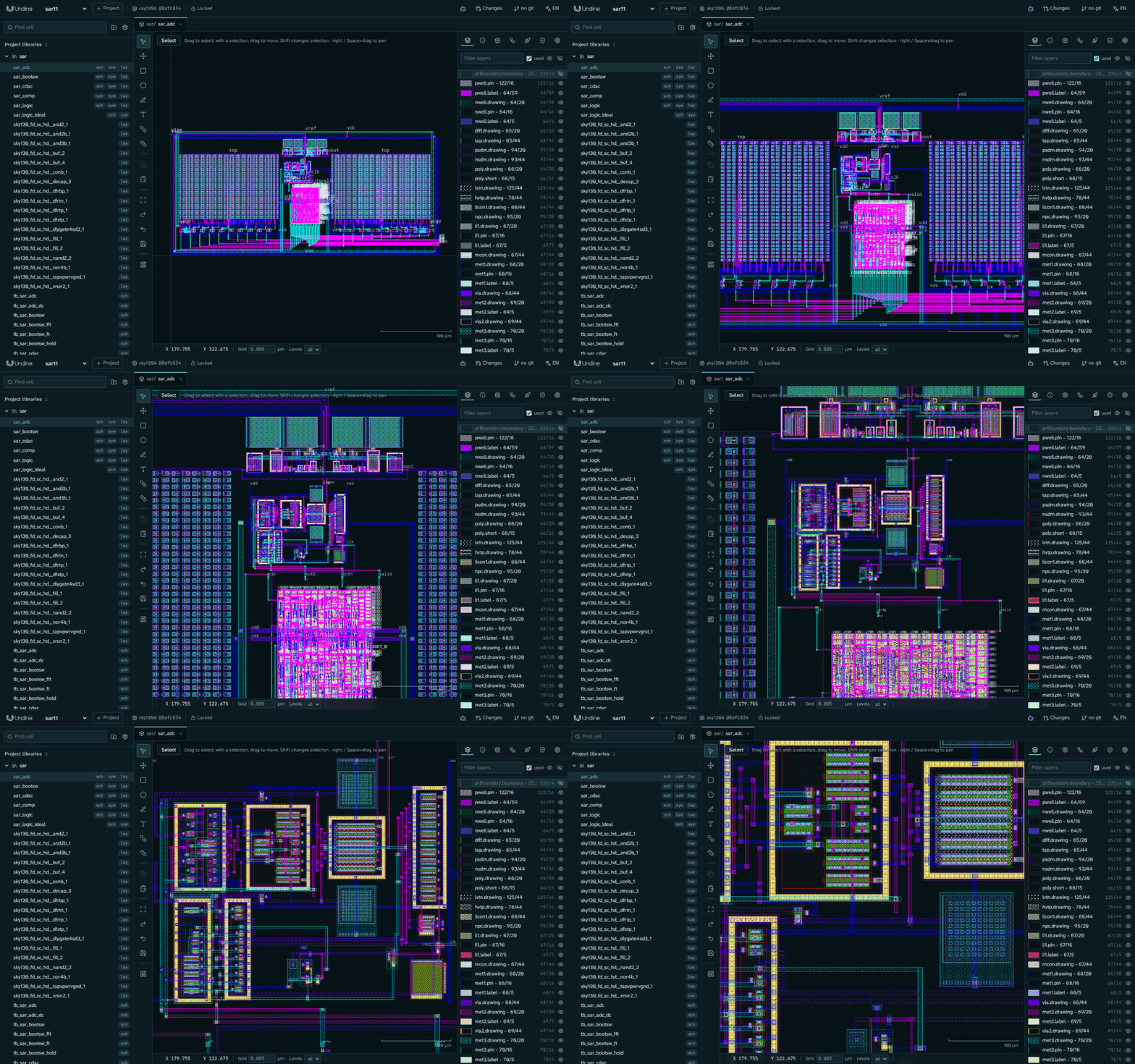
Showcase: an 11-bit SAR ADC
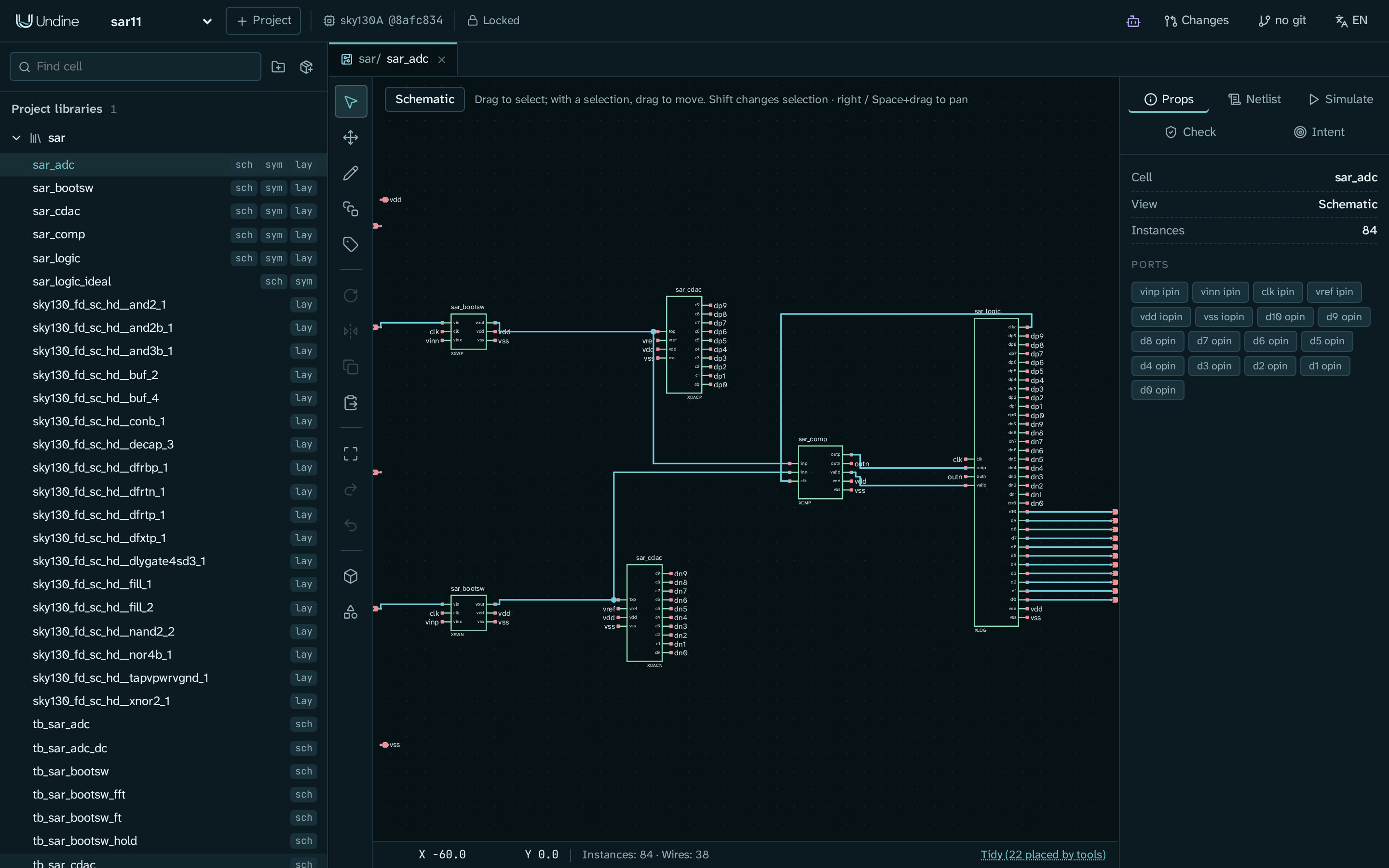
An 11-bit, 5.12 MS/s SAR ADC built in Undine with an AI agent, after The Era of Vibe Tapeout: 0.067 mm² on SKY130, DRC and LVS clean. Simulated on each block's extracted layout at the tt corner: SNDR 67.09 dB, SFDR 81.62 dB, 245 µW. The case study shows how it was built, its results, and its open items and limits.